Safety and Environment
Environment
Sustainable Energy
Biovolt vegetable oil provides technical benefits and operational cost reductions without impacting the planet’s social and environmental conditions.
Recyclable
Vegetable oils are suitable for reuse and recycling, being applied in other products, thereby contributing to environmental preservation.
Renewable Sources
Insulating fluid based on natural esters derived from renewable natural resources and raw materials, improving resource use efficiency.
Lower Environmental Impact
Formulated to minimize risks to human health and environmental safety, meeting biodegradability and toxicity criteria.
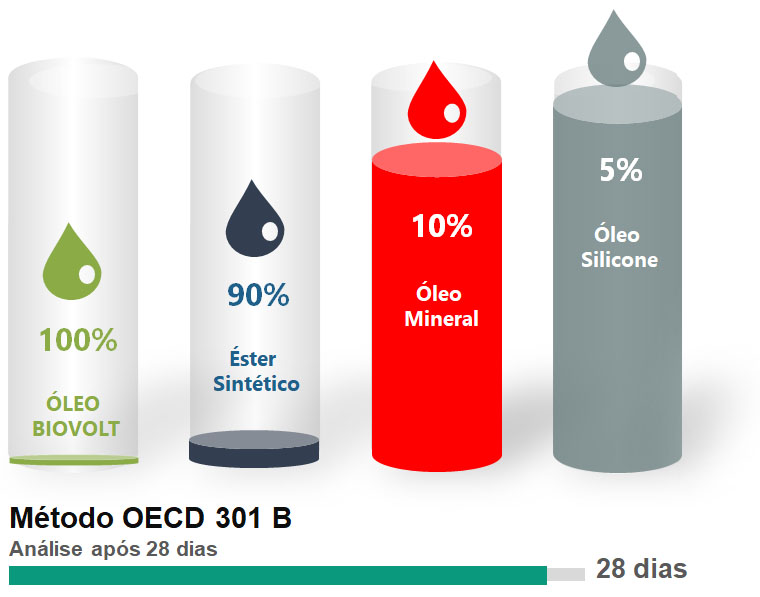
Biovolt Biodegradability
Biodegradability Rate
Comparison of Insulating Fluids
Biovolt Vegetable Oil
Excellent performance compared to other fluids.
BIODEGRADATION
Biovolt insulating vegetable oil is processed using the highest technology, with a package of additives formulated to minimize risks to human health and environmental safety, meeting biodegradability and toxicity criteria through certification tests defined by international standards.
100%
Fire Safety
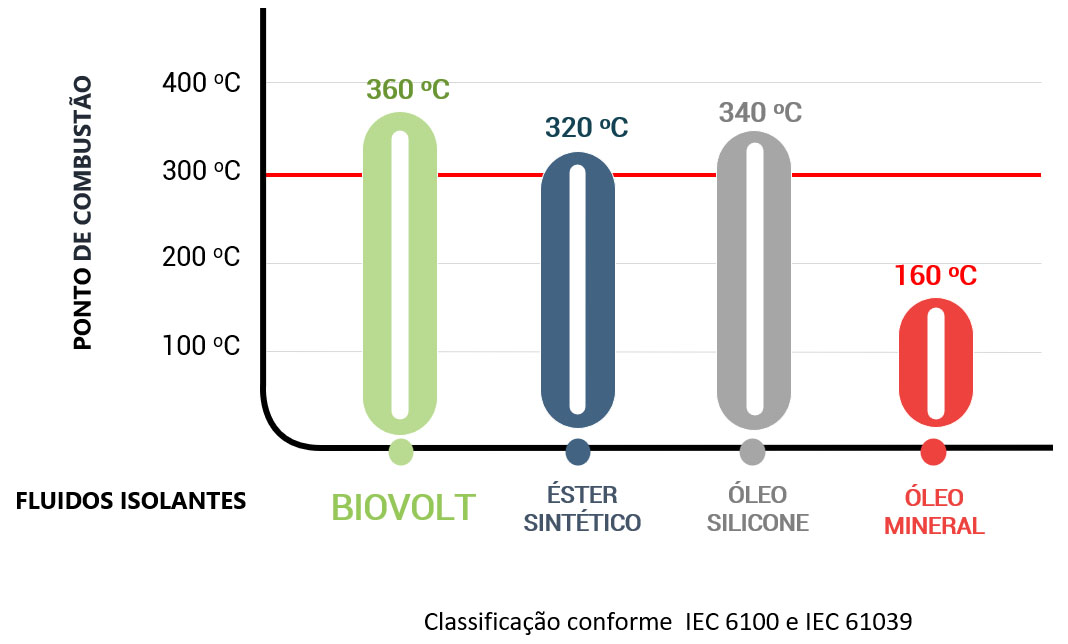
Biovolt vegetable oil has a high flash point (Class K fluid), meeting all requirements of Article 450-23 of the NEC® (NFPA 70) and IEC 6100, which define that fire-resistant liquids must have a flash point above 300 °C according to the ASTM D92 test method.
insurance premiums.
Fire safety is a major concern for companies that own transformers, especially when considering their use in areas with people circulation, near offices, inside factories, and in sheltered locations.
insurance premiums.
Insurance companies are increasingly aware of the fire potential of these devices and are encouraging users to specify transformers with insulating vegetable oil, which among many advantages, allows for reduced insurance premiums.
Using Biovolt vegetable oil provides benefits such as reduced spacing between equipment in substations and simplified fire-fighting systems due to lower fire risk.

Flash Point