


F.A.Q
- Why Use Biovolt Vegetable Oil
There is growing interest in using insulating vegetable oil for transformer applications. These fluids are being adopted by companies due to their excellent technical performance, environmental appeal, fire safety, and commitment to sustainability.
- Environmental Benefits of Using Insulating Vegetable Oil
Biovolt vegetable oil is classified as biodegradable, meeting the strict criteria set by the EPA. Costs associated with remediating potential future spills can be reduced.
- Vegetable Oil is Miscible with Mineral Oil
Biovolt vegetable oil is miscible with mineral oil, but high levels of contamination that compromise the key properties of the vegetable oil should be avoided. Replacing mineral oil with Biovolt vegetable oil has provided an important technical solution for transformers, offering benefits in safety, environmental performance, and higher load capacity without accelerated loss of service life.
- How Regeneration Works in Biovolt Vegetable Oil
Some additives in the new fluid may be removed during the recovery process and might need to be added back to the regenerated fluid.
- How Biovolt Vegetable Oil Contributes to Extending Transformer Service Life
The chemical structure of the insulating vegetable oil allows the fluid to have a water saturation approximately 15–20 times higher than mineral oil. This helps shift the water equilibrium toward the fluid, significantly reducing the effects of thermal degradation on the insulating paper, extending service life without reducing the fluid’s dielectric strength.
- Are There Voltage Class Limitations for Biovolt Vegetable Oil?
Test results, reaching voltages as high as 1800 kV in non-uniform field distribution, indicate that the breakdown voltage (BDV) and dielectric strength of Biovolt fluid are equivalent to mineral oils in all cases, except for extremely divergent geometries (needle-to-plane), where Biovolt fluid shows reduced BDV. This requires further investigation, justifying the current use of safety margins.
- Why Biovolt Vegetable Oil is Classified as Fire-Resistant (Class K)
The classification of fire-resistant liquids depends solely on their flash point, with insulating vegetable oils falling into this category with a flash point above 300 °C. Using Biovolt allows for the elimination of fire-mitigation equipment, firewalls, and simplifies containment systems in substations.
- Can DGA (Dissolved Gas Analysis) Be Performed on Biovolt Vegetable Oil?
The same analysis procedures can be used for Biovolt vegetable oil. A specific Duval triangle has been developed for insulating vegetable oils, along with an IEEE C57.155 publication for dissolved gas analysis in insulating vegetable oils.
- Interfacial Tension is an Important Property for Vegetable Insulating Oil, as It Is for Mineral Oil
This property is used to detect polar contaminants in mineral oils. In contrast, vegetable oils are not affected in the same way, having slightly lower values due to their chemical structure, which allows the values to remain practically stable throughout the transformer’s operational life.
- Can Biovolt Vegetable Oil Be Used in Transformers with Free Breathing?
Biovolt vegetable oil is not recommended for equipment that operates in continuous contact with ambient air due to its chemical structure. Even though fluid oxidation may occur over the long term, benefits such as extended transformer life could be compromised.
- How to Dispose of Biovolt Vegetable Oil After Use in Transformers
Used insulating vegetable oil can be recycled and also used as a raw material for biofuel production.
- Can Thermo-Vacuum Treatment Be Performed on Insulating Vegetable Oils Similar to Mineral Oil Transformers?
Thermo-vacuum treatment is an efficient method to reduce the gas and water content of an insulating vegetable oil to very low levels.
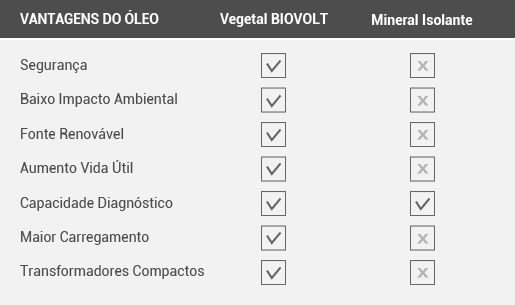
- What Are the Advantages of Biovolt Vegetable Oil Compared to Mineral Insulating Oil?